Εμφάνιση αναρτήσεων με ετικέτα PONCELET. Εμφάνιση όλων των αναρτήσεων

Σάββατο 30 Μαρτίου 2013

ORTHOPOLAR CIRCLES

Let ABCD be a quadrilateral [quadragon], A',B',C',D' the circumcenters of BCD, CDA, DAB, ABC, resp. and P a point.

Denote:

1 = the orthopole of PA' wrt BCD

2 = the orthopole of PB' wrt CDA

3 = the orthopole of PC' wrt DAB

4 = the orthopole of PD' wrt ABC

Conjecture:

The points 1,2,3,4 are concyclic. The circle passes through the Poncelet point of ABCD (=the point where the NPCs of BCD, CDA, DAB, ABC concur)

The circle (1,2,3,4) is a line when ABCD is cyclic (ie A' = B' = C'= D' = O ==> PO = PA' = PB' = PC' := L, a line psiing through the circumcenter of the cyclic ABCD)

Antreas P. Hatzipolakis, 30 March 2013

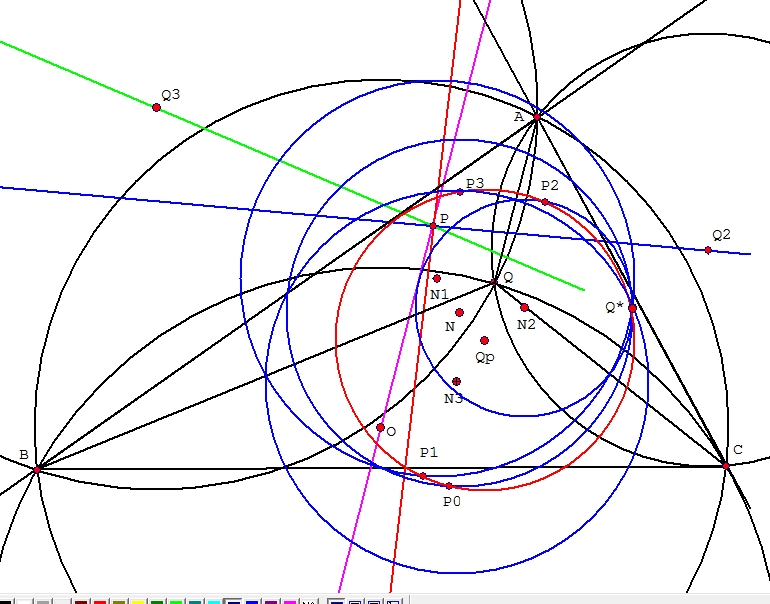
ORTHOPOLAR CIRCLES [triangle]

Let ABC be a triangle, P, Q two points and O, Q1,Q2,Q3 the circumcenters of ABC, QBC, QCA, QAB, resp.

Denote:

P0 = the orthopole of PO wrt ABC

P1 = the orthopole of PQ1 wrt QBC

P2 = the orthopole of PQ2 wrt QCA

P3 = the orthopole of PQ3 wrt QAB

We have:

1. P0, P1, P2, P3 lie on the NPCs (N),(N1),(N2),(N3) of ABC, QBC, QCA, QAB, resp. (since the respective lines pass through the circumcenters of the respective triangles)

2. The NPCs of ABC, QBC, QCA, QAB concur at the Poncelet point Q* of Q wrt ABC.

CONJECTURE:

The points P0, P1, P2, P3, Q* are concyclic.

Antreas P. Hatzipolakis, 30 March 2013.

Κυριακή 10 Φεβρουαρίου 2013

A PONCELET POINT ON THE EULER LINE


Let ABC be a triangle, (N),(N1),(N2),(N3) the NPCs of ABC,NBC,NCA,NAB, resp. [concurrent at pN]. The NPCs of the triangles N1N2N3, NN1N2, NN2N3, NN3N1 concur at point ppN on the Euler Line of ABC.

Generalization:

Let ABC be a triangle, P a point, (N),(N1),(N2),(N3) the NPCs of ABC, PBC, PCA, PAB resp. [concurrent at pP]. If P is on the Euler line of ABC, then the NPCs of N1N2N3, PN1N2, PN2N3, PN3N1 concur at point ppP on the Euler Line of ABC.(??)

Antreas P. Hatzipolakis, 10 Febr. 2013

*********************************************

pP is the center of the rectangular circumhyperbola through P.

ppP does not, in general, lie on the Euler line.

Some results:

P=X(1), the NPCs are concurrent, with center = non-ETC 1.121590125545969 (on lines 1,5 3,962).

P=X(2), ppP=non-ETC 1.690358502447462

P=X(3), ppP=X(140)

P=X(4), ppP=undefined

P=X(5), ppP=X(3628)

P=X(6), ppP=non ETC 0.780037257060191

P=X(7), ppP=non ETC 0.750876768572663

P=X(8), ppP=non ETC 2.966801160450799

P=X(9), ppP=non-ETC 0.972023454564163

P=X(10), ppP=non-ETC 2.238481946743318

P=X(20), ppP=non-ETC 6.363850996796102

P=X(21), ppP=non-ETC -1.717011738240629

P=X(22), ppP=non-ETC -4.036288926987237

Of these, only X(140) and X(3628) lie on the Euler line.Β The ppP for points P on the Euler line do not even lie on the same conic.

Locus?

Randy Hutson, Hyacinthos #21519


LOCUS PROBLEM

1. Problem by Antreas Hatzipolakis Solution by Francisco Javier García Capitán LOCUS PROBLEM 1 2. Problem by Ant...